
Arizona Voters’ Agenda Offers New Look at Election Confidence and Voter Priorities
2026 research shows views of election security, safeguards, access, and Arizona’s political system across the electorateArizona voters express more confidence in the security of the state’s elections than the political debate might suggest. But that confidence is not shared evenly across the electorate, and Republicans consistently view several key election questions differently from the majority of Arizona voters.
Those are among the findings on election issues from Center for the Future of Arizona’s (CFA) statewide nonpartisan public opinion survey research for the 2026 Arizona Voters’ Agenda.
CFA’s Arizona Voters’ Agenda has repeatedly shown substantial agreement across political affiliations and generations on many of the priorities facing the state. When it comes to elections, statewide majorities emerge on several questions, but Republican voters hold substantially different views on election security, noncitizen voting, existing voter identification safeguards, and voting access.
That leaves Arizona with an important opportunity to examine why some voters have lower confidence in the state’s elections, and what is shaping those views.
“Elections are how Arizonans choose the people who will shape our state’s future,” said Dr. Sybil Francis, Chair, President & CEO of CFA. “That system is strongest when people understand it and have confidence in it. Our research shows we have a strong foundation, but also real gaps in confidence. We should take the concerns of all Arizonans seriously, examine them against the facts, and respond accordingly. Where there are problems, we should fix them. Where there are gaps in understanding, we should make sure people have clear, credible information about how our elections work.”
A Majority Expresses Confidence, Republicans Differ
Sixty-five percent are confident in the security of Arizona elections, which includes 86% Democrats, 69% among independent and unaffiliated voters, and 45% Republicans.
The same pattern appears in perceptions of noncitizen voting. The majority of voters (54%) do not believe a significant number of noncitizens are voting in Arizona elections. Forty-one percent believe there are a significant number of noncitizens voting which includes a vast majority of Republicans (72%), 31% independent and unaffiliated voters, and 11% Democrats.
The finding measures voter perception, not the prevalence of noncitizen voting, and the survey did not define “significant” for respondents. Arizona law requires proof of citizenship to register to vote.
“There is a significant rift between where the majority of Republican voters are and the rest of the electorate when it comes to election issues,” said Paul Bentz, Sr. Vice President of Research and Strategy at HighGround, which conducted the survey. “While overall confidence remains strong, the majority of Republicans view Arizona’s election system much more skeptically. This should concern all of us. Trust in our election system is fundamental to making our representative government work. We need to understand what is driving this gap and what can be done to restore confidence among these disaffected groups. Otherwise, we risk continued conflict around how our elections are conducted.”
Statewide Majorities Also Differ From Republicans on Key Election Policy Questions
That distinction carries into questions at the center of current election policy debates.
Six in ten Arizona voters said the state already has strong voter identification laws, and additional requirements for voting by mail could make it harder for eligible voters to participate, including 91% of Democrats, 64% independent and unaffiliated voters, and 32% of Republicans. Sixty-three percent of Republicans favored requiring additional proof of citizenship, such as a birth certificate, before receiving a mail ballot.
Voters also considered access and speed. Sixty-three percent prioritize convenient and accessible voting even if final results take longer, while 34% prioritize faster results even if some voting options are reduced. The access position is supported by 84% of Democrats and 74% of independent and unaffiliated voters, while 56% of Republicans prioritize faster results.
These findings put an important distinction into the public conversation. Some election proposals may have strong support among Republican voters without representing the preference of most Arizona voters or agreement across political affiliations.
Shared Expectations Offer a Way Forward
Differences in confidence are only part of what Arizonans have told CFA about elections.
CFA’s Good Elections Project, released earlier this year, asked Arizonans what a good election should deliver, regardless of party or outcome. The research shows substantial agreement on the answer.
The findings from the Good Elections survey show 97% of Arizonans believe fair and secure elections are essential to a healthy democracy. Overwhelming majorities say elections should be accurate, trustworthy, transparent, safe, accessible, fiscally responsible, participatory, convenient, and timely. Accuracy ranks first across political affiliations.
The research also found 81% support continuing early voting by mail, with majority support across political affiliations, and 66% trust state and local election officials to administer elections fairly, accurately, and securely, again with majority trust across political affiliations.
The findings also point to the importance of credible information. More than 80% are concerned about misinformation and disinformation affecting elections, and voters identify state and local election officials as their most trusted sources of election information.
That creates something concrete to build from. Arizonans share expectations for what good elections should deliver, and they place significant trust in the officials closest to how elections actually work. Those foundations can help leaders examine why confidence differs, strengthen public understanding, and consider proposed changes against the qualities Arizonans themselves say matter.
Why do Arizonans looking at the same election system come away with different levels of confidence? What would help close that gap?
Those questions also guide CFA’s work with local leaders to build greater shared understanding around Arizona elections, grounding conversations in facts, helping people better understand how the system works, and considering what leaders and election officials can do to strengthen public understanding and trust
“Arizona already has something important to build from,” Dr. Francis added. “Arizonans agree on what they expect good elections to deliver. Leadership now means getting to the root of why we have such strong differences of opinion on key issues. We need to separate problems that need fixing from lack of understanding or misinformation about how elections work in Arizona, look beyond the immediate political debate, and follow the facts. That is how we make decisions that strengthen our election system and the public’s confidence in it.”
CFA is conducting a second Arizona Voters’ Agenda survey later this month, with new findings and additional questions for candidates and leaders expected in September.
Explore the research and join the conversation. Find the Arizona Voters' Agenda and Good Elections Project findings, methodology, and resources at arizonafuture.org/ava.
About the Arizona Voters’ Agenda Survey
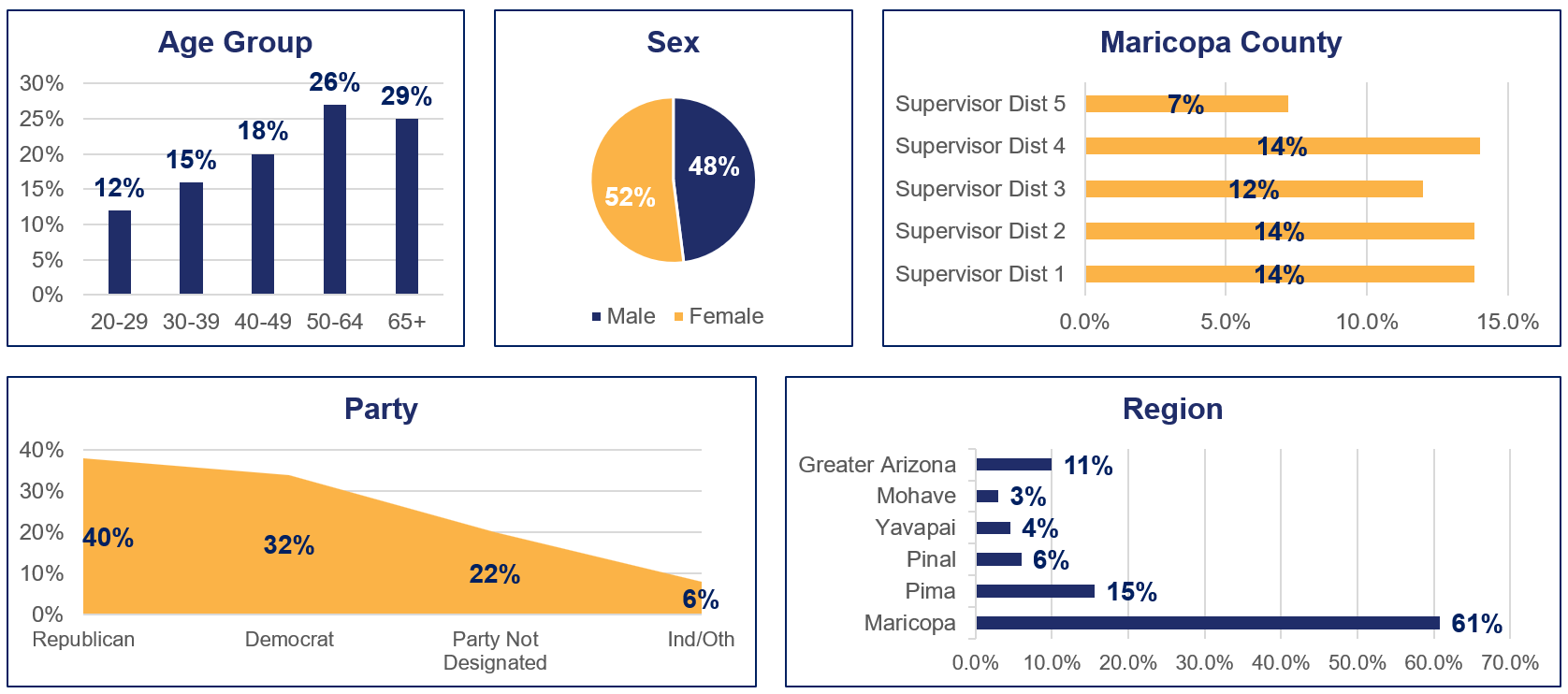
The first of two statewide 2026 Arizona Voters’ Agenda surveys was conducted on June 15-18, 2026. The poll surveyed 500 likely Arizona General Election voters with a history of electoral participation and was balanced to reflect expected turnout across party, age, region, and gender. Live interviews were conducted in English and Spanish by HighGround, Inc., among landline and cell phone users. The partisan advantage was set at +8% GOP based on previous election trends. The margin of error is ±4.3%.
To be included in the Arizona Voters' Agenda, each priority must receive support from at least 50% of all likely voters, as well as at least 50% of Republicans, Democrats, independents/unaffiliated voters, and every age group. The survey also includes broader questions that provide context about Arizona voters' experiences, concerns, and perspectives. Additional methodology is available at arizonafuture.org/ava.
Survey Demographics:
The 2026 Arizona Voters’ Agenda initiative is supported in part by Arizona State University, Helios Education Foundation, Pivotal Foundation, and Thomas R. Brown Family Private Foundation. Center for the Future of Arizona is grateful for their investment in trusted, nonpartisan research that helps inform leadership and public dialogue around Arizona's future.
About Center for the Future of Arizona
Center for the Future of Arizona (CFA) is a nonprofit, nonpartisan "do-tank" that brings Arizonans together to create a stronger and brighter future for our state. Through its survey research & communications, Arizona Progress Meters, and impact initiatives & programs in education, workforce, and civic health, CFA listens to Arizonans to learn what matters most to them, shares trusted data about how Arizona is doing in those priority areas, brings critical issues to public attention, and works with communities and leaders to solve public problems. CFA’s work is focused on building The Arizona We Want –a research-informed vision of success for the state, where all Arizonans, now and in the future, thrive and enjoy sustained prosperity, unmatched quality of life, and real opportunity.
CFA develops the Arizona Voters’ Agenda initiative to put the voices of Arizona voters at the forefront of election dialogue, encourage candidates and media to focus on what Arizonans agree on and care about for our state, and increase voter engagement by building a positive agenda that focuses on outcomes that voters across age and political affiliation want. Visit arizonafuture.org/ava for more details on the initiative and comprehensive survey information.