
Housing Leads Financial Pressures as Arizona Voters Voice Concern About Affordability
New Arizona Voters' Agenda research reveals widespread concern about rising costs and provides insight into how voters want leaders to approach housingAffordability is a widespread concern for Arizona voters, with new statewide public opinion research by Center for the Future of Arizona (CFA) showing rising costs affecting voters across the electorate and housing emerging as the leading source of financial strain.
The findings are part of CFA’s 2026 Arizona Voters' Agenda research, which identifies the priorities likely Arizona voters across political affiliations and generations agree on and provides broader insight into their experiences, concerns, and perspectives.
Affordability concerns extend well beyond those experiencing the greatest personal financial strain. Voters see rising costs as a challenge affecting people across Arizona, with implications for families, communities, the workforce, and the state’s long-term prosperity.
The research shows widespread concern about affordability and evidence of personal financial strain across the electorate. Nine in ten voters believe it is difficult for most Arizonans to cover basic monthly expenses, and nearly half (48%) say it is difficult for them personally to do so. At the same time, 82% say the cost of living in Arizona has worsened over the past two years.
“Arizona’s future depends on people being able to build good lives here,” said Dr. Sybil Francis, Chair, President & CEO of CFA. “When affordability begins to constrain those opportunities, it becomes more than a household issue. It becomes an Arizona issue. Voters clearly recognize the challenge. Now leaders need to show how they will respond.”
One indication of those broader consequences: 43% of voters overall say rising housing and other living costs have made them more likely to consider moving to another state. The share is higher among younger and middle-aged voters: 69% among ages 20-29, 49% among ages 30-39, and 52% among ages 40-49. Life stage may influence some of these differences, but for a state that depends on attracting and retaining workers, families, and talent, the findings suggest affordability is worth considering not only as a household issue, but as a workforce and competitiveness issue.
“What stands out is the consistency of the affordability concern,” said Paul Bentz, Vice President of Research and Strategy at HighGround, which conducted the survey. “The degree varies, but we see concern across political affiliations and age groups. This isn’t isolated to one segment of the electorate. Affordability is a significant concern across Arizona’s electorate.”
Housing Is the Clearest Pressure Point
When voters were asked which costs are contributing most to financial strain in Arizona, housing ranked first at 52%, ahead of wages not keeping pace with inflation at 44%, groceries at 28%, and other household costs. Housing was the top response across political affiliations and age groups, underscoring its central role in Arizona’s broader affordability challenge.
The 2026 findings build on several election cycles of Arizona Voters’ Agenda research. Since CFA began examining housing more closely in the Agenda in 2022, voters have consistently identified housing affordability and availability as concerns and supported a role for state and local leaders in addressing the challenge. This year’s research examines how voters view some key decisions in Arizona’s housing conversation.
The findings reveal both openness to expanding housing choices and a strong preference for local decision-making:
- 66% of voters would support more housing options, including duplexes, townhomes, casitas, and homes on smaller lots, in their communities if doing so helped address housing affordability. This reached 37% strong support among all voters and support from 50% Republicans, 66% independent/unaffiliated voters, and 86% Democrats.
- 68% believe communities should maintain control over housing development decisions, even if that limits how much housing gets built. That position receives majority support across political affiliations and age groups and was preferred over the alternative of making it easier to build more housing, even if local communities have less control over development decisions.
Voters are open to expanding housing opportunities while prioritizing local decision-making. That combination makes the question of how leaders would improve housing affordability particularly important.
“Arizona voters have been clear for years that housing affordability is a priority,” Dr. Francis added. “What these findings give us is a better understanding on which to build. There may not be one simple answer, but there is common ground. That gives Arizona a strong foundation for making progress.”
The Question for Arizona: What Will Leaders Do About Affordability?
The Arizona Voters’ Agenda is designed to keep voters’ priorities visible throughout the election by grounding public dialogue in what voters themselves have identified. Identifying those priorities is only the first step. The larger question is how candidates and leaders will respond—and whether areas of agreement can ultimately translate into meaningful progress.
The affordability findings raise important questions: What would candidates and leaders do to make Arizona more affordable for the people who live and work here? How would they expand housing opportunities while respecting local decision-making? How would they help ensure Arizona remains a place where workers and families can afford to build their future?
The goal is to bring voters’ priorities more clearly into the election conversation and encourage candidates and leaders to respond with plans, priorities, and solutions. Beyond Election Day, keeping those priorities visible creates a foundation for accountability: Are leaders acting on what voters have identified, and are areas of agreement translating into meaningful progress?
CFA will release issue-specific findings from the 2026 Arizona Voters’ Agenda through Aug. 20. Additional research examining water, immigration, elections, and education will continue to explore where voters agree, what their concerns reveal, and the questions those findings raise for candidates and leaders.
CFA is also conducting a second Arizona Voters’ Agenda survey later this month, with new findings and additional questions for candidates and leaders expected in September.
Explore the research and join the conversation. Find the Arizona Voters' Agenda findings, methodology, and resources at arizonafuture.org/ava.
About the Arizona Voters’ Agenda Survey
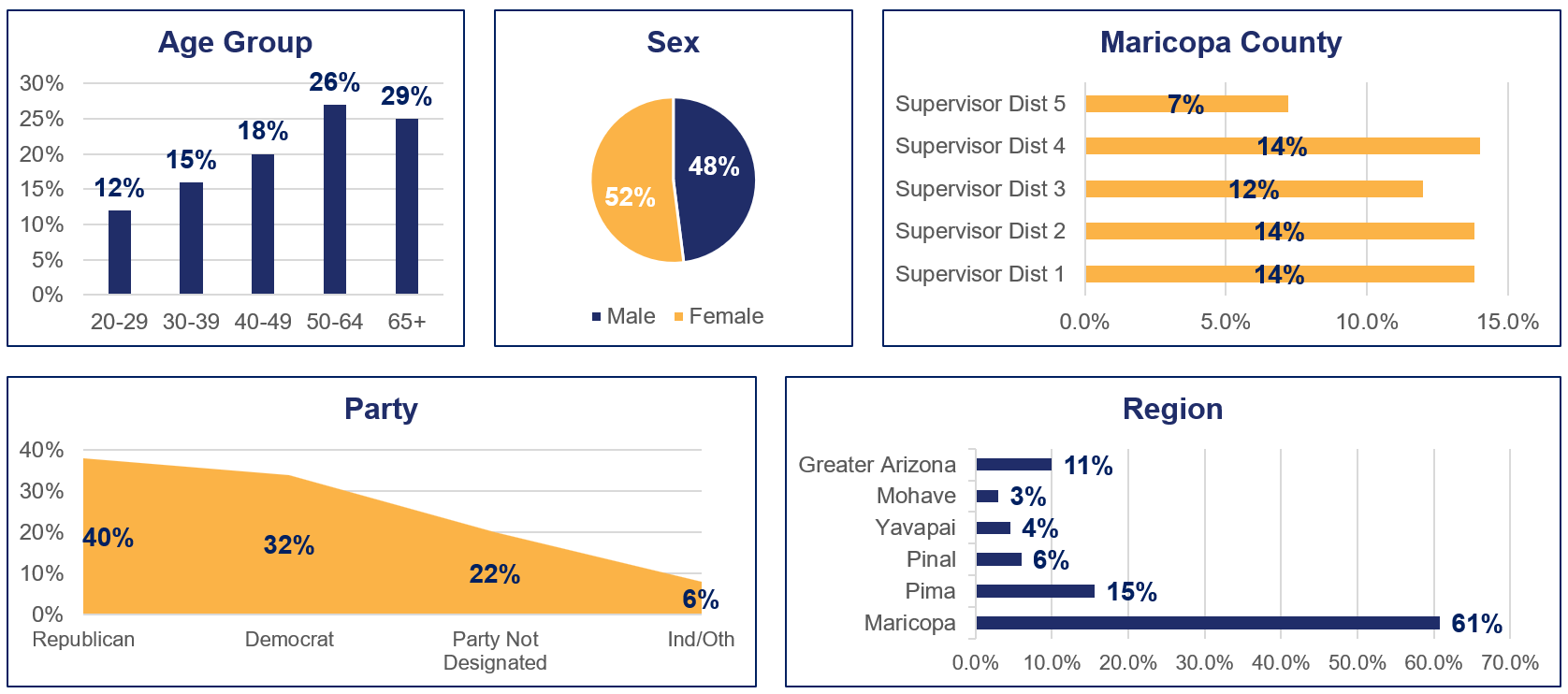
The first of two statewide 2026 Arizona Voters’ Agenda surveys was conducted on June 15-18, 2026. The poll surveyed 500 likely Arizona General Election voters with a history of electoral participation and was balanced to reflect expected turnout across party, age, region, and gender. Live interviews were conducted in English and Spanish by HighGround, Inc., among landline and cell phone users. The partisan advantage was set at +8% GOP based on previous election trends. The margin of error is ±4.3%.
To be included in the Arizona Voters' Agenda, each priority must receive support from at least 50% of all likely voters, as well as at least 50% of Republicans, Democrats, independents/unaffiliated voters, and every age group. The survey also includes broader questions that provide context about Arizona voters' experiences, concerns, and perspectives. Additional methodology is available at arizonafuture.org/ava.
Survey Demographics:
The 2026 Arizona Voters’ Agenda initiative is supported in part by Arizona State University, Helios Education Foundation, Pivotal Foundation, and Thomas R. Brown Family Private Foundation. Center for the Future of Arizona is grateful for their investment in trusted, nonpartisan research that helps inform leadership and public dialogue around Arizona's future.
About Center for the Future of Arizona
Center for the Future of Arizona (CFA) is a nonprofit, nonpartisan "do-tank" that brings Arizonans together to create a stronger and brighter future for our state. Through its survey research & communications, Arizona Progress Meters, and impact initiatives & programs in education, workforce, and civic health, CFA listens to Arizonans to learn what matters most to them, shares trusted data about how Arizona is doing in those priority areas, brings critical issues to public attention, and works with communities and leaders to solve public problems. CFA’s work is focused on building The Arizona We Want –a research-informed vision of success for the state, where all Arizonans, now and in the future, thrive and enjoy sustained prosperity, unmatched quality of life, and real opportunity.
CFA develops the Arizona Voters’ Agenda initiative to put the voices of Arizona voters at the forefront of election dialogue, encourage candidates and media to focus on what Arizonans agree on and care about for our state, and increase voter engagement by building a positive agenda that focuses on outcomes that voters across age and political affiliation want. Visit arizonafuture.org/ava for more details on the initiative and comprehensive survey information.